
Dismantling The Lie That Mount Kenya People Only Vote For Their “Own”
The entire postcolonial period is replete with evidence that the Mt. Kenya region elects candidates based on its interests, not ethnicity, but a narrative has emerged that desires to paint the region as tribal in their political choices
During President Mwai Kibaki’s first tour of Mount Kenya region few weeks after he won the presidential election in December 2002, something interesting happened.
Organisers of the presidential excursion had planned it to be exclusively a Mount Kenya affair. They had wanted to specifically deny limelight to then Roads minister Raila Odinga who was in the entourage.
The first stop-over was at Kenol township on the Nairobi-Thika highway. Here, the President stood to greet the crowd and introduce Cabinet ministers accompanying him. When it was Raila’s turn to speak, the crowd demanded that he addresses them as they shouted: “Njamba! Njamba!” (the brave one). This was replicated at all stopovers all the way to Kibaki’s hometown of Othaya. Raila was the man of the moment. And despite Kijana Wamalwa being the Vice President then, the public perception in Mount Kenya and elsewhere was that Raila was number two in the pecking order.
Indeed, opinion is almost unanimous that had Raila not fallen out with Kibaki in the 2005 referendum campaign, he most likely would have been Mount Kenya’s man in the Kibaki succession race. However, all indications are that a relatively youthful and impatient Raila was making the same mistakes that DP William Ruto is currently making – washing his hands well before dinner has been announced.
Personally, Kibaki did not have a problem with a Raila presidency. I learnt this from then assistant minister in the Office of the President Mirugi Kariuki (now deceased) who was Kibaki’s trusted confidant and legal advisor on political matters.
Mirugi told me of a meeting at State House, Nairobi, where some tribal chauvinist had remarked that everything must be done to stop Raila from taking over when Kibaki’s term ended. He noted that Kibaki did not take it kindly and replied: “What is wrong if Raila were to be president? Is he not a Kenyan like you and I?”
I would also learn from a confidential source that in the hotly contested 2007 presidential election, a close confidant had expressed concern to Kibaki that the ground looked pretty hostile and wondered what would happen should Raila win the election. Kibaki reportedly shrugged off and said: “Well, if he wins we just swear him in!” That is an eventuality that some of Kibaki’s men could not stomach and was ready to pull out all the stops.
Granted, can Mount Kenya voters for an “outsider”? A wrong perception been conveniently created over time, particularly since the multiparty era, that Mount Kenya residents can only vote for one of their “own.” Sadly, the perception isn’t borne out by the facts.
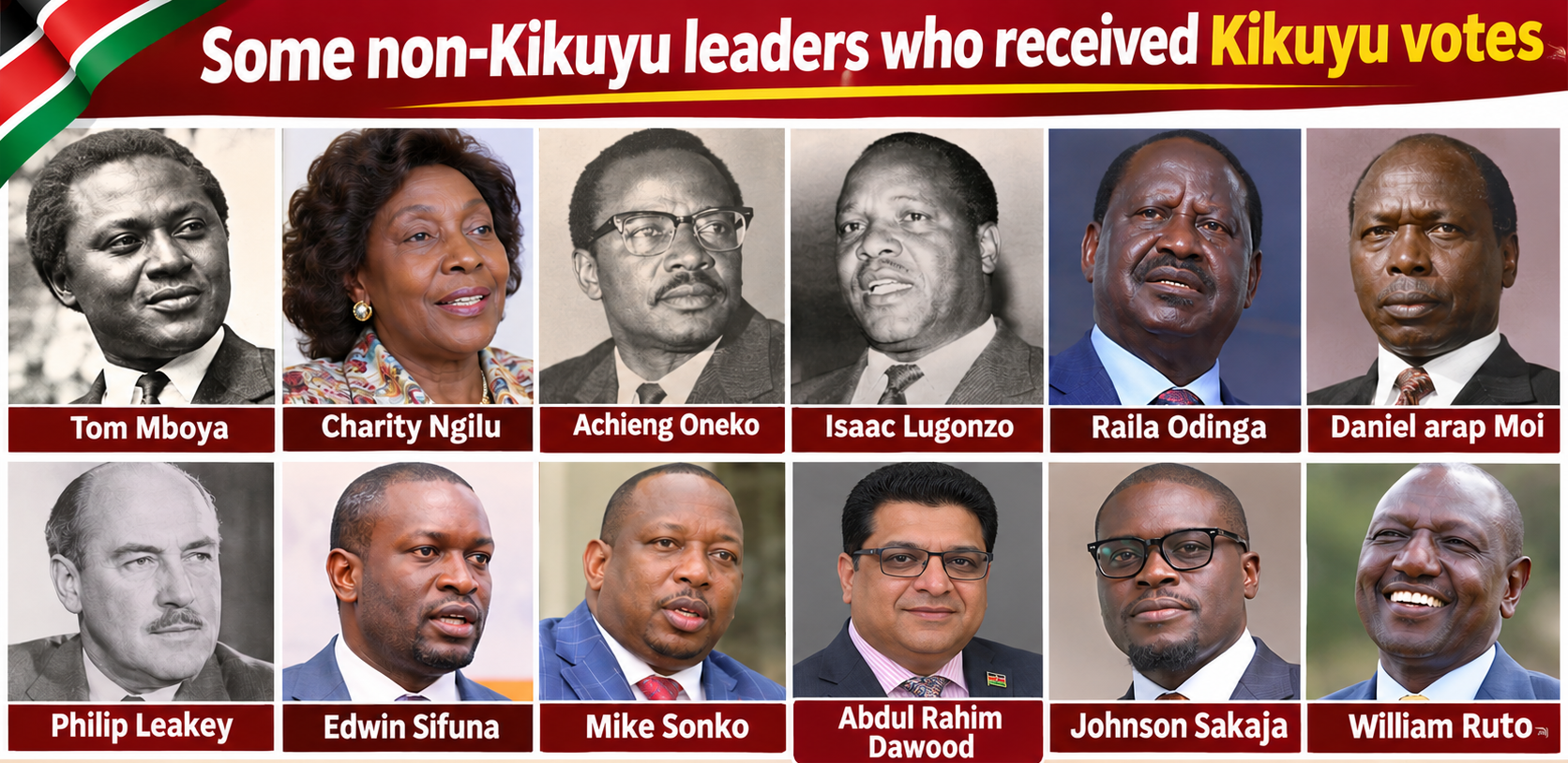
An analysis of historical voting patterns is very revealing. Let’s start with first independent elections in 1963. In the Kikuyu-dominated Kamukunji constituency in Nairobi, Tom Mboya, a Luo, easily beat a Kikuyu candidate, Dr Munyua Waiyaki, who hailed from nearby Kiambu. Elsewhere in Nakuru town constituency, another Kikuyu bastion, Achieng Oneko, a Luo, won with a landslide.
Indeed, Nakuru is perhaps the best illustration that Kikuyu people, and Mount Kenya at large, vote for individuals based on merit, and as long as the candidate aligns with community interests, and not on basis of their ethnicity.
Currently, one of the two MPs representing urban Nakuru—Nakuru Town West— is a Kisii, Samuel Arama. In the neigbouring Rongai constituency, also largely Kikuyu-populated, Raymond Moi, a Kalenjin is the MP. Kikuyus in the constituency saw him as a safe bet compared to others candidates considered hostile to the community.
In the competitive 1992 multi-party elections, Dr. Lwali Oyondi, a Luhya, was voted Nakuru Town MP, a predominantly Kikuyu constituency, on a Ford Asili ticket. Before him, other non-Kikuyus made it to Parliament largely on Kikuyu vote in Nakuru, including Eric Bomett, Willy Komen, William Kimosop, and Alicen Chelaite. Alicen Chelaite is still fondly remembered for distributing development projects without discrimination.
Earlier on, another election had underscored that Kikuyu vote for their interests. History was made when in the 1966 general election in Nakuru East constituency, a Kenyan of British ancestry, Babu Wood, floored a Kapenguria Six hero, Fred Kubai. Kikuyus abandoned a freedom fighter and a war hero in favour of a non-Kikuyu!
In Nairobi, Philip Leakey, a white, and Khrisna Gautama, an Asian, were elected in then Kikuyu-dominated constituencies of Langata and Parklands (renamed Westlands) in the 1979 elections. Later Amin Walji, a Kenyan of South Asian origin, would beat Betty Tett and Wanguhu Ng’ang’a, both Kikuyus in the same constituency.
Also noteworthy is the fact that in the last two general elections, an Indian, Rahim Dawood, has twice been elected and re-elected MP deep in Meru.
In Murang’a, a Luo was for many years elected councilor in the defunct Murang’a County Council, and in the last election a Luo was voted Member of County Assembly (MCA) in the Wendani area of Kiambu County on a Jubilee ticket. After his death in India, he was eulogized as a great leader who worked well with the majority Kikuyu people who loved his courage and leadership.
It is also a fact that the huge Kikuyu ”Diaspora” In Kajiado, Uasin Gishu, Trans Nzoia, Mararal, and Lamu, have always voted in non-Kikuyu candidates.
Even with the above examples, some people would still argue that Kikuyus will vote for a non-Kikuyu except in the presidential ballot. That, too, is a lie.
Many forget that it is the Kikuyu who hoisted Daniel arap Mo to the presidency in 1978. When Moi was Vice President, the most influential of Kalenjin leadership had issued what was called the “Nandi Declaration” where they denounced his leadership.
And although a renegade group of Kikuyu chauvinists, led by Kihika Kimani, were opposed to Moi’s ascendancy, the most influential and level-headed Kikuyu leadership (including the “deep state” in the security apparatus), stood with him even when the pressure was so much that he reportedly contemplated throwing in the towel.
I remember a conversation I had with Kimani wa Nyoike (now deceased), a former influential trade unionist and secretary general of the then giant Union of Civil Servants. He recalled Moi, then VP, and secretly met him one evening. Moi confided that since the two largest and most influential of Kalenjin sub-tribes, the Nandi and Kipsigs (Moi was from minority and impoverished Tugen), did not support him, he would be counting on the support of the Kikuyu to succeed Mzee Jomo Kenyatta. Moi wanted Nyoike to assure him of his support.
It is also a fact that in 1992, Mount Kenya voters were ready to vote Jaramogi Oginga Odinga for President in the united Ford if Kenneth Matiba was his running mate. Indeed, it is a fact that it is ethnic chauvinists around the two politicians who sabotaged a Jaramogi-Matiba ticket, not the ordinary “Wanjiku.”
All this boils down to one question: Do Mount Kenya vote for interests or ethnicity?
In the 1963 election, the overarching interest of the electorate in the Mountain was defeat to colonialists and the party deemed to have been started by colonialists to frustrated independence – KADU.
In Nairobi, it is Mboya, not Waiyaki, who stood the best chance to whitewash the KADU candidate, thus the Kikuyu overwhelmingly voted for him. Similarly, Achieng Oneko was Kikuyu’s best bet to win in the white-settlers bastion of Nakuru.
And in 1978, the community fully backed Moi’s ascendancy to power on assurance they would be allowed to live and do business in any part of the country, particularly in the Rift Valley.
In the 1979 election, it is Philip Leakey and Khrisna Gautama who had best development agenda, and so the Kikuyu voters endorsed them and not “their own”— Wachira Waweru and Mwangi Mathai, respectively.
In 1992, the Kikuyu were ready for a Jaramogi-Matiba ticket because it was the sure guarantee to serve their interest, which at that time was almost limited to voting out Moi and KANU.
Primarily, the Kikuyu wanted Moi out, not because he was a Kalenjin, but because he had reneged on his promise to ensure them, and indeed all Kenyans, that they were free to live and do business in any corner of the country without being unduly targeted.
From the foregoing, it is clear that Mount Kenya’s overriding interest, more so in the coming post-Covid dispensation, is to have a conducive environment to rebuild livelihoods in agribusiness and other sectors in any part of the country. This is a desire that other communities too harbor although most are too shy to express it.
As illustrated by the March 2018 handshake, a political rapprochement with Raila is best bet for a peaceful environment to do business and rebuild the economy. Tied to that is a predictable election calendar. As it is now, every election cycle has been engulfed in uncertainty and fear, which is big drawback on stability and investment. Working with, not against Raila, is perhaps the best guarantee for a predictable political environment. In the last two elections, Raila proved he has the support of nearly half the country, therefore he cannot just be wished away.
The third interest, but which is very crucial to Mount Kenya, is elimination of corruption and theft of public resources. The vice is a huge drag on the economy and enemy of business and honest entrepreneurship which the region is known for. Again, Raila is best placed to help rein in the run-away graft and theft. Most of the other aspirants eyeing the top job have proved that given a chance, they will mortgage the whole country to the highest bidder in the name of “hustling,” which is being interpreted as the pursuit of wealth and money without being encumbered by inconveniences such as the law.
This should, therefore, answer the question whether the Mount Kenya electorate can endorse a Raila presidency. The simple answer is, yes, they would, and I am not saying that he will be the candidate. But with a qualifier that he takes care of their interests or the edifice crumbles.0°
