
My Encounters With Nairobi’s Traffic Extortion Racket
I was arrested by Nairobi City County askaris for simply driving in Nairobi and forced to part with money. If that is not extortion, then the word has lost all meaning. Disband the askaris. Give our roads back to the National Police Service. And let no Kenyan ever again be forced to pay simply to go about their lawful business.
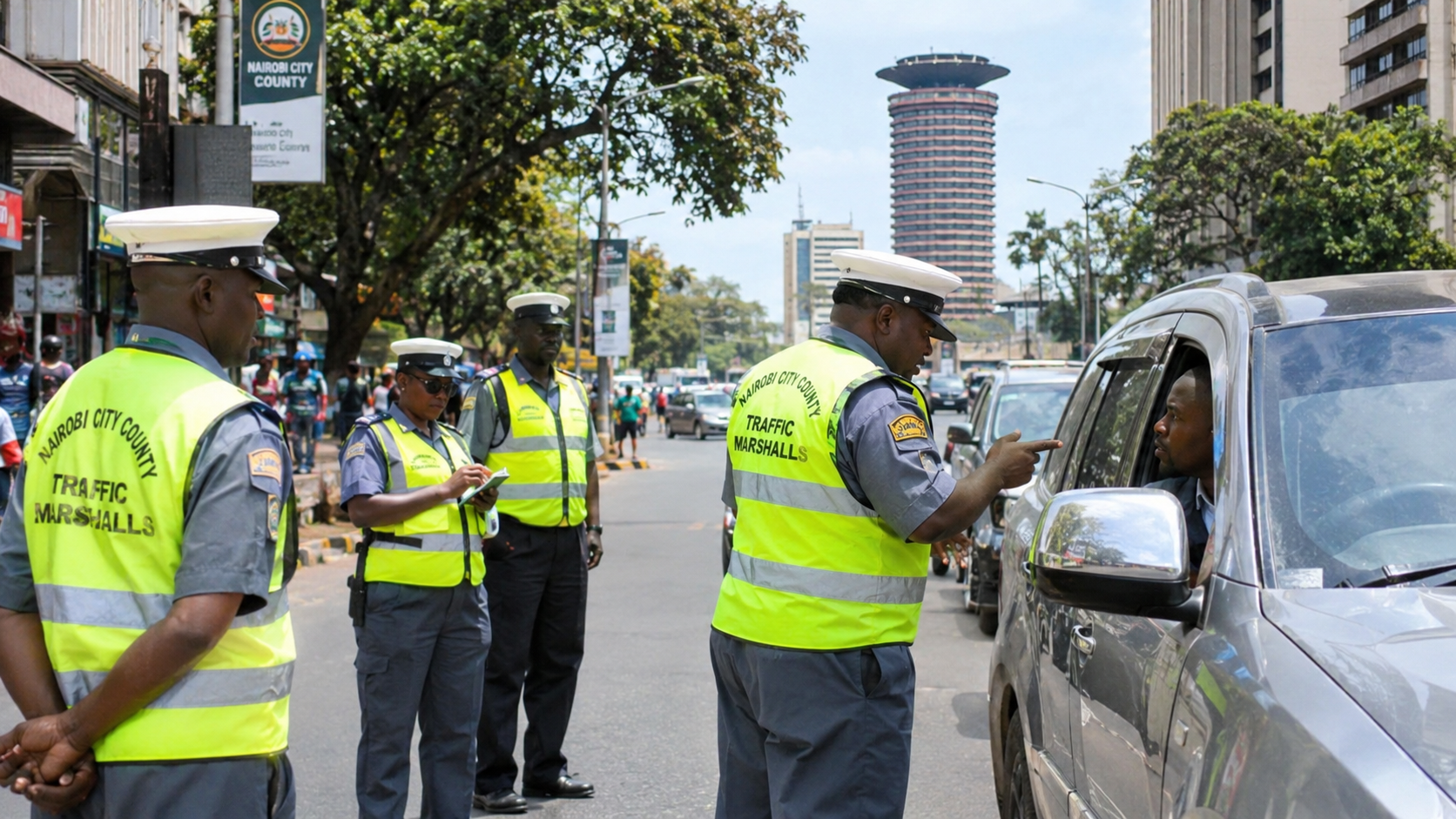
I have been arrested twice in Nairobi’s Central Business District without committing a crime My only offence, if you can call it that, was making a turn and driving in traffic. For this, my friends and I have paid KES 7,500 to men in blue uniforms who wear the cloak of law enforcement but operate like a criminal enterprise.
Let me be clear from the outset: what I experienced was not law enforcement. It was extortion. Pure, unadulterated, brazen extortion. And it must stop.
The First Arrest: A Turn into Monrovia Street
It began innocently enough. I made a turn into Monrovia Street from Koinange Street. A man who looked like a traffic policeman, wearing blue uniform and a white checkered cape, flagged me down with unmistakable urgency. Like the good citizen that I am, I stopped.
He told me I had not stopped at the zebra crossing. Before I could even respond, his buddies were all over my car, demanding to be let in. The one who had arrested me was making frantic phone calls to headquarters, reading my car plates aloud and claiming I had obstructed traffic.
The man told me he needed to get into my car to accompany me to their station where they take impounded cars. When I opened the door, four men got into my vehicle. Four. I was told to drive. Traffic was heavy, barely moving. And yet, these same officers started complaining that I was driving like I was in a hurry. I wondered silently: how fast could anyone drive in a traffic jam?
Then came the punchline. They volunteered, “for my knowledge,” that the fine was KES 30,000. To cut a long story short, I parted with KES 2,500 and was let go. No receipt. No court date. No formal charge. Just cash exchanged in the middle of traffic.
The Second Arrest: Justice for Sale
The second incident was even more egregious. The President was in Parliament delivering the annual State of the Nation address. The entire CBD was in gridlock. Cars were barely moving.
I got out of the parking at the former Intercontinental Hotel, and presidential security directed me into City Hall Way, where I was stuck in traffic for a full 45 minutes. Eventually, I got onto Wabera Street, where I was arrested, yet again, for not stopping at a pedestrian crossing.
Same script. I was told to accompany the enforcers to a station near St. Peter Clavers Church. Once again, four men got into my car. The smell of their sweat accosted my nostrils. But this time, I insisted on my rights. I wanted to be charged. I wanted to go to court. I demanded that evidence of my alleged infringement be produced.
I called a friend, a businessman who works at Viewpark Towers and explained to him the bind that I was in. He asked to speak to one of the askaris and I handed the phone to one of them. The askari explained that I was being “adamant and difficult.” I heard them agree to immediately send “an agent of theirs.” The agent collected money from my friend and then called the people in my car, apparently to confirm that he had the money.
Immediately they received confirmation that their agent had received the money, they opened the door and abandoned me in traffic. I could not abandon my car to chase after them. The incident became one of the smoothest robberies I had ever experienced.
My friend later told me he had parted with KES 5,000. I asked him why. His advice? “I thought our time is more valuable. Do you know how much time you would have wasted at the station? Do you know parts of your vehicle could have disappeared in that parking lot? Are you sure they would not concoct evidence? My friend, wake and smell the coffee. This is Nairobbery! You do what you have to do to survive. Don’t bother me again if you don’t do what you should do when in Rome.”
When in Rome, I was told, you pay. But this is not Rome. This is Nairobi. And what is happening on our streets is not justice, it is an extortion racket operating under the guise of traffic enforcement.
The Pattern Is Clear
My experience is not unique. It is part of a systemic pattern of corruption that has been documented repeatedly by journalists, investigators, and ordinary Kenyans who have been victimised by these uniformed extortionists.
Consider the case of Gloria Ntazola, a Nairobi businesswoman who recounted an incident at Jeevanjee Gardens where four county askaris approached her car as she tried to park. Two officers managed to get inside her vehicle, with one insisting she was in the wrong despite her having paid for parking. Aware that officers are not allowed to enter a motorist’s car without consent, she refused to be bullied.
Instead, she drove off with the askari still inside, taking him on a long trip through Kilimani, onto the Nairobi Expressway, and eventually dumping him in Kitengela. She stated she wanted to teach him a lesson for trying to waste her time and extort her, noting that he seemed unable to call for backup during the ride.
Then there is the case of Elizabeth Jebii Bischof, a motorist who, through her lawyers, issued a legal demand to Nairobi City County after an incident near Nyayo House. She had parked her car but found the county’s official parking app non-functional. When she explained the situation to a county officer, she was threatened with a penalty ticket and pressured to pay cash informally. The officer allegedly demanded money to “watch over” her car. She only discovered there was an alternative Paybill payment option after calling county offices directly, which highlights how officers exploit digital glitches to extort motorists.
And then there is the “towing racket” targeting parked cars. Investigations and editorials have highlighted a systemic extortion scheme where motorists, even those with valid paid parking fees, have their vehicles clamped or towed by rogue city inspectorate officers colluding with private breakdown operators. Owners are then slapped with demands of at least KES 10,000, sometimes up to KES 20,000, to release their vehicles, despite the legal fee being only KES 1,000. The money rarely reaches the county treasury and is instead shared among the cartels and officials.
Even our legislators have taken notice. During a Nairobi County Assembly session, an Honourable Member raised concerns about the Inspectorate’s behavior, stating that askaris were acting like a “money-minting mechanism.” The member specifically mentioned that city askaris follow hard-working Kenyans, such as taxi drivers, when they are dropping off clients and demand as much as KES 20,000. The legislator noted that instead of enforcing the rule of law, the officers were asking for money, effectively robbing people of their hard-earned cash.
This Is Extortion, Not Enforcement
Let us call this what it is. The conduct of these traffic marshals is not law enforcement. It is extortion. It is robbery with a badge. It is organised crime operating in broad daylight.
The evidence is overwhelming. Motorists are arrested on trumped-up charges. They are forced to let multiple officers into their vehicles, which is a clear violation of their rights and personal security. They are threatened with exorbitant “fines” that bear no relationship to the actual penalties prescribed by law. They are pressured to pay cash on the spot, with no receipt and no record.
This is not a few bad apples. This is a systemic problem. The entire operation appears designed not to enforce traffic laws but to generate revenue for individuals who have weaponised their uniforms for personal enrichment.
The Solution: Disband the Traffic Marshalls and Transfer Traffic Enforcement function
I have a radical proposal: disband the Nairobi traffic marshals entirely and transfer traffic control to the National Police Service.
Why? Because the current system is irredeemably compromised. The Nairobi City County Inspectorate has demonstrated, time and again, that it is incapable of self-regulation. Its officers operate with impunity, shielded by a culture of corruption that starts at the top and permeates every level. Attempts at reform have failed. Internal oversight is non-existent. And the public has lost all confidence in their ability to act with integrity.
The National Police Service, for all its faults, at least has a formal command structure, disciplinary procedures, and mechanisms for accountability. Traffic officers within the NPS are subject to the Police Service Act and can be investigated by the Independent Policing Oversight Authority (IPOA). They are required to wear identification, issue formal citations, and follow established procedures for arrests and fines.
Is the NPS perfect? No. Corruption exists there too. But the difference is that there are systems in place, however imperfect, to hold officers accountable. The same cannot be said for the Nairobi inspectorate, which operates as a law unto itself.
A Demand for Action
I am not naive. I know that disbanding an entire department and transferring its functions is a significant undertaking. But the status quo is unacceptable. The current situation has created a climate of fear and lawlessness on our roads, where motorists are treated as prey and officers as predators.
I write this not because I expect to recover the KES 7,500 already clearly spent on bribes. I write because I am angry. I am angry that I was forced to pay for the “crime” of driving in traffic. I am angry that my rights were violated by men who are supposed to protect them. I am angry that this is happening to thousands of Kenyans every single day, and that we have come to accept it as normal.
It is not normal. It is extortion. And it must stop.
The president has spoken about the need to fight corruption. The governor has promised to reform the county. Our legislators have raised concerns about the inspectorate. But words are not enough. We need action.0°
