
To Break The Stalemate, Adopt The Original CRA Formula
Allow counties ‘to breathe again’ and shift focus to a quest for an enhanced Equitable Share
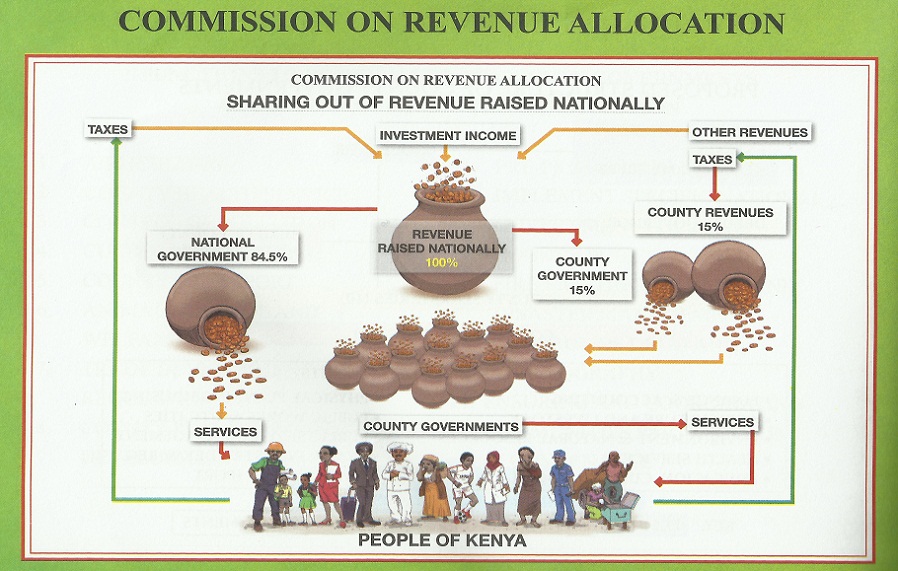
For the past two months, Kenyans have been treated to a near paralysis of service delivery in the counties courtesy of the unprecedented political brinkmanship in the Senate. Many are bewildered and unable to fathom just how the August House of Senate, ostensibly established to nurture and protect the sub-national governments, has been totally unable to resolve revenue sharing in spite of making nine attempts followed by weeks of intense negotiations by a special committee of the House.
Part of Kenyan’s public bemusement with the apparent impasse stems from their fundamental presumption that the Commission on Revenue Allocation (CRA) is the institution mandated to work out the revenue sharing formula and hand it over to Parliament for implementation. For good measure, previous recommendations appear to have been adopted, approved and implemented without much fuss. The 64-million dollar question now is the Senate has, all of a sudden, deemed it fit to dismiss what appears to have been a well thought-out, dispassionate, forward-looking and data-informed formula for allocating the sharable revenue.
In attempting to answer these vexing questions, we need to revisit the mandate of the constitutional commissions and establish what ‘we the people’ contemplated when we set up 10 of them alongside two independent offices (the so-called Chapter 15 institutions in the Kenya Constitution 2010).
The Commissions include the National Land Commission (NLC), the Kenya National Commission on Human Rights (KNHCR), Parliamentary Service Commission (PSC), Judicial Service Commission (JSC), Commission on Revenue Allocation (CRA), Public Service Commission (PSC), Teachers Service Commission (TSC) and the National Police Service Commission (NPSC). The two independent offices are the Controller of Budget and the Office of the Auditor General.
There are, however, other constitutional commissions that do not necessarily fall under Chapter 15 of the Constitution. These include the Ethics and Anti-Corruption Commission (EACC), the Commission on Administrative Justice (CAJ of the Ombudsman), the National Gender and Equality Commission (NGEC) and the Kenya Law Reform Commission (KLRC).
These institutions are charged with the administration and oversight of specific functions. Their utility resides in their ability to render specialized services that only they have the requisite competence to do. Framers of the constitution were convinced that parliament has absolutely no capacity in the highly complex areas administered by these agencies. What most people in the legislature have is a loud mouth guaranteed to sensationalize and to huff and puff, not expertise.
In situation is the same in many other jurisdictions, including the US where a veritable alphabet soup of regulatory agencies and departments exists to protect citizens from the wiles of coughing politicians gone in the national legislature.
Since the establishment of the British Navy Board in 1546 as a specialized agency for ships and supplies, the post-great depression ‘New Deal’ which saw the proliferation of Federal Agencies in the USA to the more recent New Public Management discourse of the 1980s, nation states have increasingly turned to agencies or specialized institutions in an effort to improve efficiency in public service delivery.
For obvious reasons in the liberal democratic context, certain institutions are also established for purposes of deepening democracy and entrenching good governance practices. The administrative agencies have a distinct advantage over government Ministries and Departments. This advantage is a function of these institutions’ degree of autonomy, independence and accountability.
Whereas there was evidently some colonial influence in the way agencies and institutions of governance were established in Kenya, by the time the quest for constitutional reforms climaxed in the 1990s through to the early years of the new millennium, the citizen’s trust deficit in government was at its peak.
Due to the excesses of the KANU government and its chequered litany of human rights abuses and plunder of public resources, people yearned for a governance system that promised strong institutions of governance that could plug the obvious governance deficiencies of mainstream government.
Kenyans were not merely asking for more of the Parastatals and Semi-Autonomous Government Agencies (SAGAs) – most of which, undoubtedly, play a critical role in public service delivery. They demanded for governance institutions anchored in the constitution for greater protection, and actually dedicated a whole Chapter in the supreme law to underscore their commitment to departing from the past and establishing an efficient, freer and more open governance system.
It is clear that Kenyans did not want emasculated specialized agencies or they would not have protected them in the constitution in the first place.
Kenyans sought to have certain functions that they considered pertinent to good governance vested in institutions independent from possible capture and manipulation by the Executive and Legislative branches of government. The constitutional commissions would be granted autonomy to recruit the most suitable personnel to help them execute their mandate of rendering specialized services to Kenyans.
They would also not be under the general direction of formal state actors since they would enjoy some measure of budgetary independence. The obtaining governance arrangement is broadly in keeping with administrative law theory. In general, the commissions have highly competent professionals who love their country perhaps better than the self-serving politicians.
While it is plausible to argue that it is elections in our representative democracy that link leaders or office holders to the public, it is equally important to take cognizance of the fact that it is still ‘We the people’ who consciously deemed it fit and necessary to make provision for the Chapter 15 Commissions and that citizens can exercise their sovereignty either directly or indirectly.
The Constitution grants full mandate to the commissions to legitimately exercise public power and craft policy choices for the common good of the Kenyan people but crafty politicians who negotiated the constitution sought to limit the independence of the independence commissions in what will rank as a great conspiracy against their people.
We the people seemingly were right in suspecting that our representative bodies might not be adequately primed to adjudicate certain critical contests. This is why for instance the Commission on Revenue Allocation (CRA) was mandated to play the role spelt out in the constitution and its relevant enabling pieces of legislation.
Moreover, the fact that the constitution explicitly prescribes the involvement of a multiplicity of stakeholders in decision-making processes also helps clarify the legitimacy of our key institutions of governance. Consequently, exhaustively reasoned decision-making, which is a product of careful public participation in deliberations over the policy choice to best serve the common good, should be an adequate assurance that the recommended policy option is the most credible.
A curious argument among Senators whose counties have been granted enhanced allocations but they, in their individual capacities, have elected to oppose the formula, is that they are doing to demonstrate solidarity with colleagues whose counties had their allocations adjusted downwards.
For all practical purposes, it is improbable that a destitute household in the affected counties would thank their Senators for the heroic altruism that subordinates their equally dire needs and denies their children, for instance, a fair chance at education and potential retrieval from the vicious cycle of poverty. Other arguments advanced, such as the one by Kakamega Senator Cleophas Malala that his governor had not requested for more funds, are downright laughable. For the people of Kakamega sent only one senator to the Senate to take care of their interests.
While the CRA recommended formula is a product of rigorous technical engineering, public participation and benchmarking, the same cannot be said of the decision by the few Senators whose constituents must surely wonder whether their views and needs might not have been compromised for political expediency. Under the circumstances, the most vulnerable households in the populous counties whom the CRA had carefully considered and provisioned for might not help but feel thoroughly short-changed.
Therefore, as we celebrate the 10th anniversary of the promulgation of Constitution of Kenya (2010), it is important to appreciate that even Parliament and mainstream executive structures of governance have limitations. The myopia of the legislators might emanate from narrow political expediencies such the forthcoming elections. This is precisely why ‘we the people’ chose to establish specialized agencies, constitutional commissions and independent offices in an effort to enrich our governance architecture for the common good.
Arguably, the citizens’ expectation is that all these actors would adopt a cooperative governance approach where policy options are products of truly concerted efforts with the primary objective of enhancing service delivery performance for all without leaving anyone behind.
The current protracted impasse at the Senate is sufficient proof that CRA’s was the best possible recommendation under the prevailing circumstances since it considered data and scenarios intellectually challenged politicians can’t handle. Attempts to second-guess the CRA have only yielded months of needless and divisive political haggling with no end in sight.
It would really help, at this point, if Senate, in order to redeem itself and ward off calls for its abolition, adopted those recommendations and sought to use the Equalization Fund to correct whatever imbalances that might emerge. Most importantly, let the CRA continue churning out helpful data-informed recommendations while the Senate focuses on securing a higher percentage allocation from the sharable revenue because this is what will grant us all a credible win-win outcome.0°
