
Whether Constitutional Commissions?
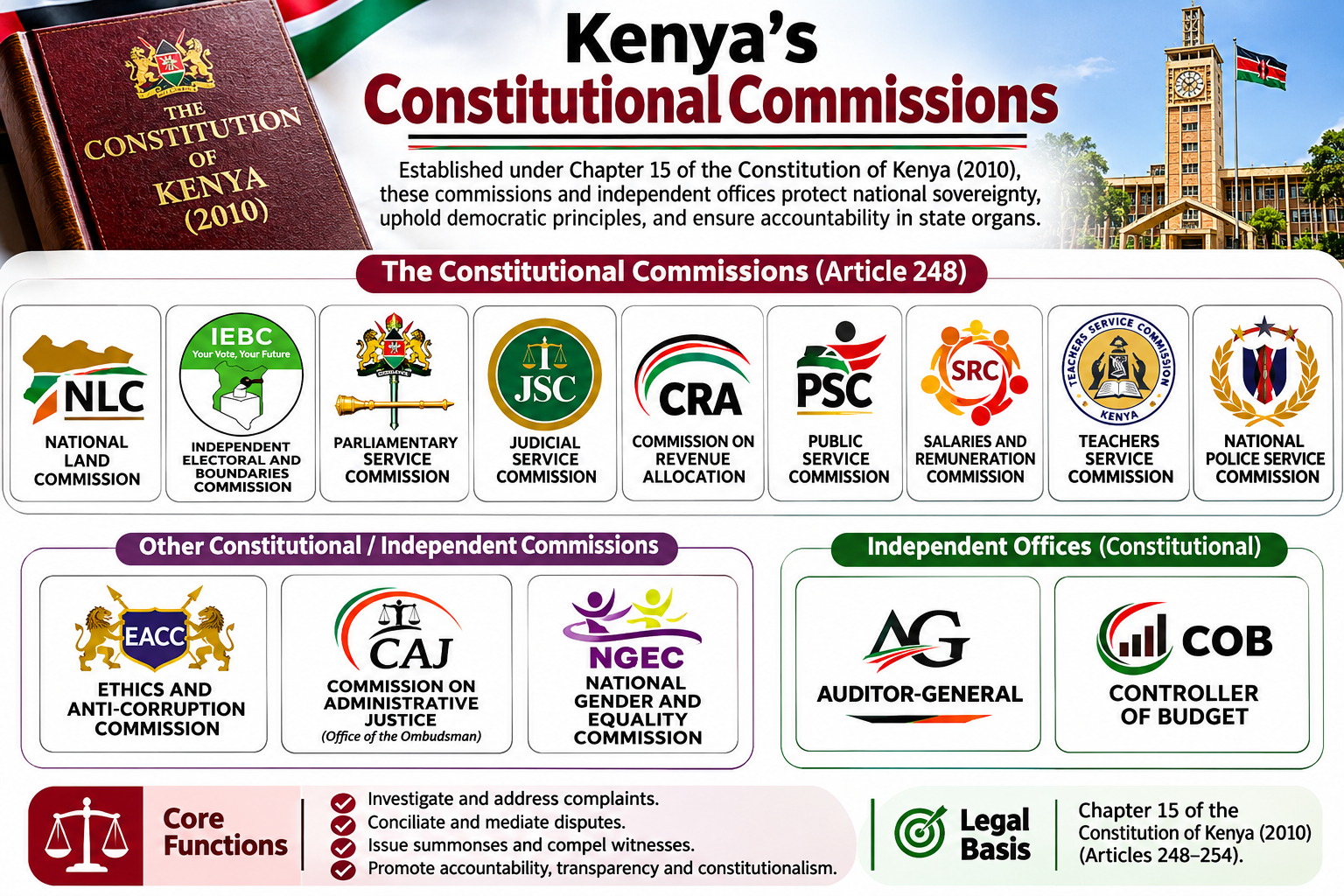
The Constitution created ten commissions to guard Kenyans' interests. A decade on, most have let us down.
It is not the mountain that is the problem; it is the stone in the shoe.
(Mohammed Ali)
This is NOT an article on revenue allocation, it begins like that, but it is not. Sure, the debate has got everyone sick and tired, but there is one other thing…
Kenyans suppose they are a highly educated, sophisticated lot, compared to their regional compatriots. But they are actually a simple people, because they are an easy people to lie to. They can believe any pie-in-the-sky mumbo jumbo as long as it is backed by numbers. The first thing Kenyans ask for when they hear any story is ‘the figures’.
Yes. You can put Kenyans into your bag and carry them away if you just back you lie with data, co-variances, correlations, graphs charts and other numerical pies.
That is what the current revenue sharing hocus pocus has been about; numbers that neither reveal nor enlighten, just numbers thrown about like a lady’s undies in the hands of a teenager with something to prove.
Billow Kerrow, the Senator for Mandera has fielded numbers that have woven a woe-begone tapestry of neglect and criminal governmental negligence. His numbers have also sought to demonize a whole region as a ravenous black-hole of governmental largesse and unrelenting me-first-ism.
The renowned public intellectual David Ndii has been a prolific publisher of numbers and graphs and charts. Numbers that have gone on to blame, debunk and demystify. Or so he says.
The Commission for Revenue Allocation, has also fielded numbers. Numbers that depict indices, percentages and rates. Of poverty, fiscal fidelity, populations per county and per-capita, health and water consumption. Numbers, numbers, left right and centre.
Politicians and Senators have jumped onto all these numbers like hogs onto mush. Each of them has pulled for ‘their people’, pushed for their counties and hogged the limelight in cackling crescendos, banged poor senate furniture, swore at the their Speaker, soiled their careers and our quiet evenings. All because they have numbers.
And Kenyans, like George Orwell’s animals in Animal Farm do not who to agree with. They agree with whoever is talking at a particular time, echoing numbers they know little about and immediately changing to agree with the opposite view and echoing its numbers.
Nobody goes for the long story of the contextual narrative. Because well, it is a long story.
Nobody has asked Billow Kerrow to account for the North Eastern region’s long and costly shifta insurgency that sure drained resources and lives from the government and the people of the region, resources that could have been used on the region’s development and people that could have made a difference. When masons left Mandera because they were attacked by terrorists, I never heard Kerrow reassure them and ask them to stay. When most of the teachers posted by the government to schools in Garissa because of insecurity, Billow Kerrow never came up with a strategy to ensure teachers never felt threatened. Insecurity is an issue that contributes to underdevelopment.
It is true, the area need massive influx of resources to catch-up with the rest of the country. But poverty and marginalisation are not the only woe in this country.What is missing from Kerrows ethnic diatribe is the people, what do his people really need?
At a risk of sounding like the devil’s advocate, Uhuru Kenyatta is right. Poverty is not the same. A poor man in Turkana may have only ten goats, three cows and one camel. A poor man in Nairobi has only the clothes on his back. But David Ndii’s and CRA’s numbers will not tell you that. They are just cold numbers. They do not tell the whole story. They leave out the most important element: the historical context and the social cultural dynamics.
So, when the CRA gave the Senate numbers and a formular, how did it expect that to translate to development for the poor of Mandera? Did the CRA think of issue like those brought to the fore by the MCA from Mandera, who was reported by Citizen TV complaining about the liberal and unilateral misuse of devolution funds by the governor?
The incompetence of this commission beggars belief.
Which brings us to the real gist of this fulmination.
What does the CRA expect when it throws the rabbit of devolution funds among the hounds that are politicians?
The current conundrum has not been caused by the Senators. It has not been caused by their grandstanding and tribal baiting. It has not, been caused by President Uhuru Kenyatta . It has not been caused by the whipping boy of Kenya’s inefficiency, the Executive.
This sad pile of fertilizer has been caused by the CRA. It is the mother, and the nursemaid of this chaos because it has abdicated its responsibility and constitutional mandate. It has shirked its cardinal responsibility to devolution and to Wanjiku.
In his signed article published on Twitter on 10th August 2020, David Ndii concluded
“…Formulas such as rates of return are helpful for illuminating discussions, but they are not of themselves solutions…put formulas aside and return to reason.’(ellipses mine)
David Ndii’s take on this matter is important because he is one of the consultants that crafted the chapter of the Constitution on Public Finance. His is a significant voice of the thinking behind revenue allocation and what the foremost thinkers on the issue had envisioned.
Article 216(1) requires the CRA to recommend a ‘basis for the equitable sharing of revenue raised by the national government….’. Such a basis is what the Senate is required to employ in the preparation of the Division of Revenue Bill.
The CRA has for 10 years ignored the criteria set out in Article 203(1), especially sub-clauses d – k, to come up with a mathematical formula to generalise, pigeon-hole and further marginalise. In this formula, the Commissions contempt for public participation as provided for in Article 10 stinks to high heavens.
The CRA must have at its disposal development experts, statisticians, policy analysts and whoever else. What could have been simpler than helping counties prepare five-year development plans, guided and supervised by the Commissions experts? The people would say what they want where, what is feasible and what is practical. They would participate in their own development and really feel a part of the democratic process. The shilling allocated to education will not be left at the mercy of the governor and his CECs. The people of Marsabit will know where they expect a school and where they expect a hospital. They will say where they need a water-pan. These five-year plans can then form the basis of negotiation, and ultimately division of revenue. It is practical, democratic and empowering.
But the CRA would rather come up with a cold formula, throw the skunk into the Senate, fold their hands and wait to eat their salaries for the next five years, doing nothing.
The division of revenue quandary that the Senate finds itself in is not caused by the Senate. Politicians in the Senate are just doing what politicians are elected to do, represent their voters’ interests. They may lie, misrepresent and dispute. There is no one senator that is called to care for other people or counties other than his own backyard. It is called rationality. And if the Senate is left to it, there may never be an end…As Thomas Sowell, the American economist says, ‘Politics is the art of making selfish interest seem as the national interest.’
It was the CRA’s job to create the policy and the Senates to implement. The CRA spectacularly failed to rise to the occasion. Will it correct course?
But it is not alone. It has the company of all the other Constitutional Commissions.
It is not the problem that is the problem, it is the solution that is.
As Kenyans say, they had only one job to do!
Charles Maina
The incompetence of this commission beggars belief.
Which brings us to the real gist of this fulmination.
Ten years after the promulgation of the Constitution, the group of institutions that this constitution created as a way of diluting the power of the Presidency and diffuse decision-making horizontally have stood out in their failure rather than success.
Almost each chapter of the Constitution came with a commission to help consolidate and further its provisions.
The Bill of Rights came with the Kenya National Human Rights Commission for instance. Who knows the chair of this commission? As Kenyans are clobbered by the police and arrested arbitrarily, who has even an example of when they raised a sound in protest?
The chapter on Public Service created the Public Service Commission. This commission is really a misnormer for it has committed itself to nothing like the public service. A Moi-era Head of Public Service still calls the ultimate shots in the public service. There is also a CS in charge of the Public Service. How this Commission sleeps at night after abdicating its Constitutional role and gorging on a huge budget is the stuff of miracles. The only commission in this chapter that has been seen to be on its toes has been the Teachers’ Service Commission, thanks to vibrant teachers’ unions.
The National Police Service Commission long left its seat to the CS Interior. This commission is quickly going out of radar. Nobody remembers that the NPSC is the employer of police officers and the CS has no business firing any police officers. The Commission’s abdicating of its role to protect police officers’ mandates has left their careers flapping in the wind and at the mercy of the Executive. The IG cuts a sorry figure, with head bowed beside the CS Interior.
The Judicial Service Commission is just trying.
The less said about the Salaries and Remuneration Commission the better.
What about the other independent offices? How is the Controller of Budget faring for example? The Constitution provides in Article 228(5) that the CoB ‘shall not approve any withdrawal from a public fund unless satisfied that the withdrawal is authorised by law.’ To what extent has the CoB protected public funds in the last 10 years? Would the various scams have been possible had the Controller of Budget been serious with their work?
What about the ODPP? What makes the police think they can arrest Senators on spurious charges and attempt to take the matter to court? Do they really respect the integrity of the ODPP if at all they think it exists?
Point is, the various Constitutional Commissions have been a big let-down. We are where we are in terms of corruption, governance and blatant abuse of human rights because the bodies the Constitution created have abdicated their responsibility, become moribund and a financial deadweight on the shoulders of Kenya’s taxpayers.
The division of revenue quandary that the Senate finds itself in is not caused by the Senate. Politicians in the Senate are just doing what politicians are elected to do, represent their voters’ interests. They may lie, misrepresent and dispute. There is no one senator that is called to care for other people or counties other than his own backyard. It is called rationality. And if the Senate is left to it, there may never be an end…As Thomas Sowell, the American economist says, ‘Politics is the art of making selfish interest seem as the national interest.’
It was the CRA’s job to create the policy and the Senates to implement. The CRA spectacularly failed to rise to the occasion. Will it correct course?
But it is not alone. It has the company of all the other Constitutional Commissions.
It is not the problem that is the problem, it is the solution that is.
As Kenyans say, they had only one job to do!0°
Read the full text: The Constitution of Kenya, 2010 (PDF, free)
