
Of Racial Stereotypes And The Rise Of Tribalism In Kenya
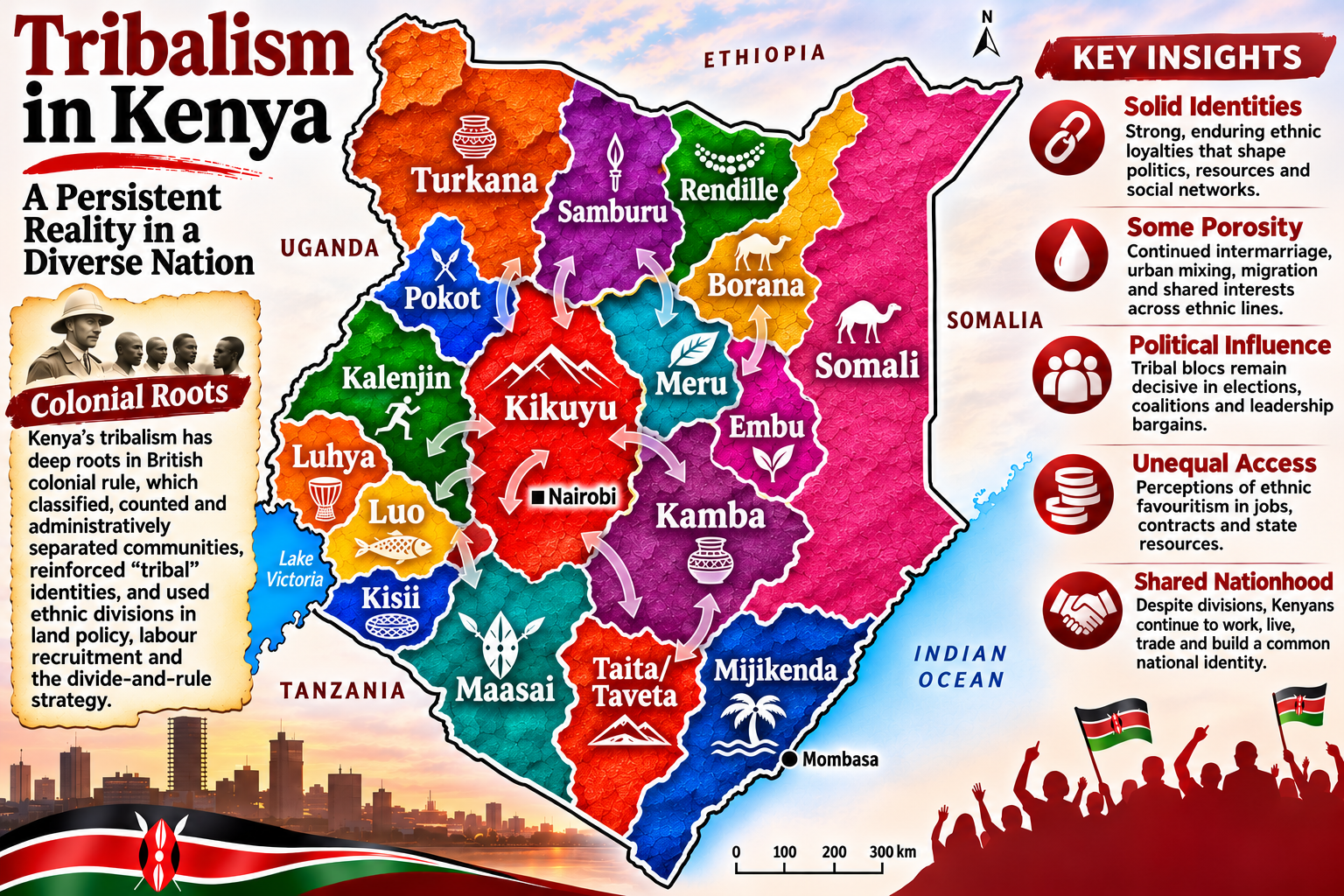
Tribalism as a phenomenon was emboldened by the divide and rule strategy employed by colonialists to conquer the country
In her book The Flame Trees of Thika, Elspeth Huxley waxes lyrical about the pleasant, rancid body odour of the Kikuyu “natives,” which she attributes to their having smeared their bodies with fat and red ochre. She writes that her enchantment with the Kikuyus derives from the fact that they “are mainly vegetarian.”
She contrasts them with a certain “savage” tribe which she claims is from Victoria Nyanza, and which she describes as “meat eaters and sometimes cannibals.” She writes that “their smell was quite different: much stronger and more musky, almost acrid, and to me, much less pleasant.”
Of all the tribes who lived adjacent to shores of Lake Victoria, we can only guess which community Elspeth was stereotyping as cannibals. On the Kenyan side, there were, and still are, two dominant communities in Nyanza. The Luo community were quite amiable and generally welcoming to the mzungu and quite often enough comprised part of the contingents deployed in punitive excursions against their neighbours, the Abagusii, under colonial DC Sir Geoffrey Northcote’s leadership between 1905 and 1911. The Luos, doing the bidding of the newcomers were, therefore, unlikely to be stereotyped as barbaric to the point of cannibalism by colonial settlers whom Elspheth was part of.
The colonialist mindset was such that they like to rank the natives according to how co-operative they were to their rule—the more hostile, the more “primitive” they were presumed to be.
The Kisii colonial DC Northcote, for instance, had no desire to learn the culture of the Abagusii and sent disconcerting and misinforming racist reports to headquarters. His reports were scary enough to discourage whites from settling in Gusiiland, save for the faith-fuelled Seventh-Day Adventists (SDA) and Catholic missionaries.
In fact the first European anthropologists to live among the Abagusii was R.A. Levine and B. Levine in the 1930s, almost 40 years after the arrival of white people in the hinterland of Kenya. Out of their adventure came the book: Nyansongo: A Gusii community in Kenya published in 1966 to become one of the earliest texts on the community.
But first, the story of the settler writers. Many European explorers and missionaries concocted stories from Africa to create the picture of the “dark barbarians” and “savages” they supposedly encountered on the continent. For example, Henry Morton Stanley, the famed explorer-journalist who first came to Africa when he was hired in 1871to search for Dr. Livingstone, the missionary who had been missing in East Africa, was again hired to rescue the besieged Emir of Pasha in the Sudans. His journey of rescue took him to Central Africa where he claims to have been the first mzungu to “discover” the pygmies.
He chronicles his journey in his book In Darkest Africa: The Quest, Rescue and Retreat of Emin, Governor of Equatoria, which was very well received, selling 15,000 copies in 1890 alone, and translated into 10 European languages. In the book there are claims of cannibalism, and yet it is a member of Henry Morton Stanley’s entourage, a young officer who had developed an obsession with cannibalism, who purchased a ten-year-old slave girl, and handed her over to some locals, who, he wrote, stabbed, dismembered, and devoured her as he sketched the macabre scene in a series of watercolours! At best, it could be the young officer’s imagination, or at worst, procured murder.
The European explorers were instrumental in spreading the racist agenda, portraying Africans as an inferior race of savages bound for extinction. To them, it was the white man’s duty to “save” and “civilize” the continent. This was the noblesse oblige, a combination of deranged moralism and a sort of pseudo-science being spewed by a group of influential scientists who called themselves “Social Darwinian” in the 19th and early 20th centuries.
The post-colonial cultural critic Edward Said observes in his epic book Orientalism that the identity of the native is a creation of the colonialists through representation and discourse. Said further argues that the identities the colonialist creates for the native are transactional. In every perspective, the colonialist’s identity is the reference.
Writers and novelists writing about the Other played a key role in conveying this eugenics narrative to the white masses. They were the opinion shapers during that era, with newspapers buying rights to popular novels and subsequently serializing them. In her book, Playing in the Dark: Whiteness and Literary Imagination, author Toni Morrison talks about how virtually all canonised mainstream white authors up to mid-20th century helped spread the racist agenda. She gives the example of Nobel Prize winner Ernest Hemingway who, in his novel To Have and Have Not, uses the black characters as props for the white heroes. The black characters are not given speech and when they talk, it is with grunts and witless, inflected speech.
Another example is F.S. Fitzgerald, who is seen as a cultural icon of the early 20th century for bringing alive the New York society in his epic novel The Great Gatsby, yet in that self-same novel he manages to wipe out the Afro-American from the rich history of New York City, more so of Harlem, the cauldron of the Harlem Renaissance. In fact, in spite of its deep roots in Harlem and Afro-American traditions, it is the Russians who perform Jazz music in the novel.
It is against this background that we begin to view our own Kenyan settler writers, starting from the egocentric John Boyes. Born in the lower working class in the highly stratified class society of Britain, he realised that when he came to Kenya, he could live his dream of royalty by imposing himself as the King of the Kikuyus. His memoir is titled John Boyes, King of the Wa-Kikuyu: A True Story of Travel and Adventure in Africa.
But Huxley and Blixen are perhaps the most famous of Kenyan settler writers. Blixen’s book Out of Africa was adapted into a movie of the same title, which won the Academy Awards in 1985, while Elspeth Huxley’s Flame Tree of Thika was turned into a BBC series in 1981. The two writers arrived in Kenya almost at the same time: Elspeth had come with her British parents as a six-year-old in 1913, while Karen Blixen was a 27-year-old Danish woman about to marry a baron and settle in the country.
It is through the two authors’ memoirs that we get a glimpse of the colonial mindset, a vivid picture of their beliefs and fears about Kenyan communities. Elspeth’s perspective is that of a child growing up amongst the Kikuyus, first at Thika, and in Njoro where the family moved later. The Huxleys’ cook is a Swahili man named Juma, but most of the farmhands are Kikuyus.
The farmhands are referred to as “boys,” even if they are over 50 years old. That again was the stereotype the colonialists had about Africans; that their minds did not grow past that of children. Elspeth is sympathetic of women, when she sees them bearing heavy loads on their backs, and carrying children while tilling the land. She feels that their men are lazy and idle — except when they come to the farm to ask for work.
It is Blixen who is more riveting in her stereotyping of Kenyan communities. In Out of Africa, she writes that the British government refused to recruit the Maasai to fight by its side against the Germans during the World War I, apparently because it did not think it was wise to allow Maasai to be engaged in combat against white men.
Elsewhere, she observes that: “The Somalis are a religious people, yet the Maasai have no religion, nor the slightest interest in anything above this earth. The Somalis are clean, and take much trouble over their ablutions and hygiene, while the Maasai are a dirty nation.” Never mind that the Maasai had a monotheistic deity, Engai, very much like the Christian God.
She seems to place the Somalis high in her weird tribal hierarchy, as evidenced by her use of phrases such as “natives and Somalis.” This is not surprising at all. The colonialists regarded any of the tribes who had embraced Islam and therefore knew how to read and write as less primitive. If they were serving white people, they were regarded even better. This is how in Nigeria, they created the rift between the Igbo and Yoruba on one side and the Hausa on the other.
How then is the colonial racist stereotyping connected to the tribalism that continues to afflict the country? In his book Political Power and Tribalism in Kenya published in 2018, Dr Weston Shilaho observed that tribalism in Kenya is a recent phenomenon emboldened by the colonial masters divide and rule strategy.
The stereotyping is the mechanism through which the colonial masters entrenched tribalism. Quoting works of scholars from the school of African Studies such as Mahmood Mamdani, Bruce J. Berman, Archie Mafeje, Eisha Stephen Atieno Odhiambo and Prof Bethuel Ogot, among others, Shilaho argues that all Kenyan tribes are a construct—a random, artificial amorphous identity like the nation known as Kenya (Kenya was created by the Europeans in the Berlin conference of 1884 when the imperialists divided Africa amongst themselves).
The scholar notes that before the invasion by colonial rulers, ethnic identity was fluid, with communities in a state of flux. This meant that Ethnic boundaries changed in a contested and negotiated fashion, making it difficult to define ethnicity. He gives the example of the Abasuba, who were originally Bantu but were assimilated by the Luos, the same way that Ndorobos were acculturated by the Maasais, the Kikuyu and the Kalenjin. There were no fixed boundaries and the Maasais could graze their cattle from the coastal strip, through Ukambani, Mt Kenya to the Rift Valley.
It was the colonialists who, through their racist prisms, defined and assigned the tribes as we know them today. Several culturally linguistically-related communities in Rift Valley attained the name Kalenjin, as was the case in the Western region, where a hodgepodge of Bantus and Nilotic communities were baptised Luhya. Basically all Kenyan communities were given names by the colonialists, missionaries or anthropologists. The colonialists played communities against each other, successfully suppressing any idea of unity.
The colonialists adopted various strategies to reinforce these tribal conceptions, the main one being the kipande system. This saw Kenyan adults given an identity card bearing their name and tribe. In the early colonial period, the kipande was a metallic dog collar, complete with a box container for carrying identification documents, which natives were required to hang around their neck at all times. Secondly, they confined people in homogenous tribal reserves and imposed movement restrictions, thus effectively putting a stop to the organic territorial expansion of the communities.
As exemplified by Blixen and Elspeth in their books, Africans were stereotyped according to the kind of work that colonialists would assign them. For instance, the Kamba were turned into Kenya’s “martial” tribe although they were hardly the most militant or war-like community, as were the Luos and Kalenjins. These communities were heavily recruited into the colonial army and police. The Luhya were employed as immigrant domestic labour as every colonialist avoided hiring the Kikuyu, who were seen as untrustworthy and dangerous. But the colonialists respected Kikuyu farming skills, so they hired them as cash crop growers.
While the tribal identities assigned by colonialists gained foothold in Kenya in the post-independence era, some countries such as Tanzania denied the divisions fuel and embarked on unity through the imposition of a common language and the equalizing ideology of socialism. However, the economic cost for this experimentation to Tanzania has been immense, but the country is deemed to be a more cohesive country despite having 120 ethnic communities as opposed to Kenya’s 44.
But just as it is difficult to abolish Christianity and “restore” Kenyans to pre-colonial factory settings, it is also hard to do away with tribal identities, especially given the established political culture where the concept of tribal has been highly politicized. Many are those who say that we can use our diversities to our advantage as a nation, but the list of options in this regard does not run deep.0°
