
Kerrow Wrong On How Counties Should Share Revenue
Senator Kerrow’s article selectively maligns Mt. Kenya region and fails to explain why North Eastern counties deserve more within the contexts of the current formula
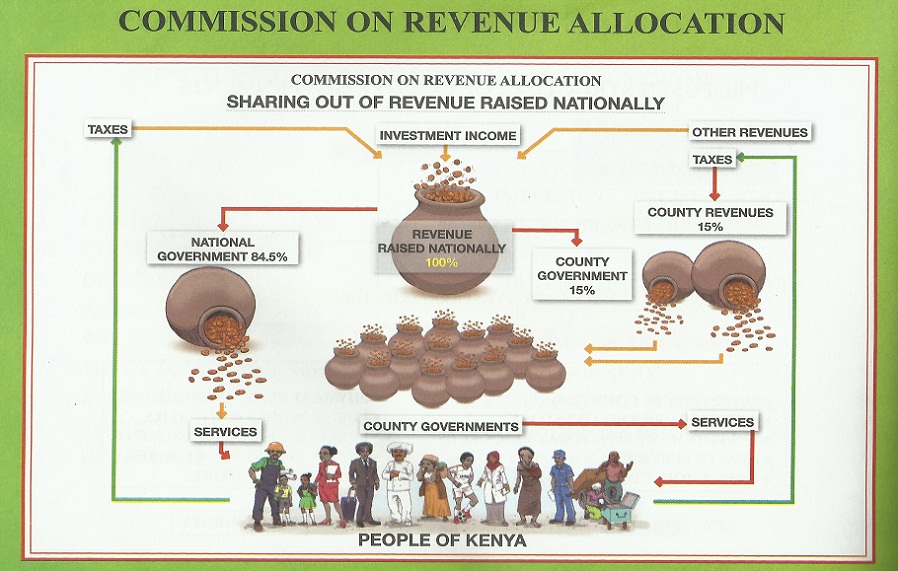
Opinions, mostly meant to asperse reasonable facts, have been widely shared on social media regarding the proposed CRA third-generation revenue sharing formula. An opinion piece authored over the weekend by former Mandela Senator Billow Kerrow, a trained economist, badly maligns the Mt. Kenya region and injuriously misrepresents the moral behind the current revenue sharing formula.
The third basis for revenue sharing has, for the fifth time, heightened contentions at the Senate on its applicability in the division of shareable revenue to county governments. Current power struggles at the Senate, some posed inexplicably by senators whose counties are set to benefit if the formula is passed, have also emerged to obscure the delicate balances that the Commission for Revenue Allocation has put into consideration in coming up with the formula. Senate reconvenes on Tuesday to determine the fate of the formula to be used in sharing the over three hundred billion shillings.
Senator Kerrow’s article in totality suggests that Central Kenya is the prime beneficiary of the third basis formula. Nothing can be further from the truth. The second basis formula, which did not benefit from considerations of the updated household information and relied wholly on the contentious 2009 population census data, failed to take into consideration the unique needs of growing urbanization across counties.
At the same time, some of the indicators employed in the second basis formula were unreliable. For instance, as a measure of poverty, the second basis considered the “poverty gap” measure as an indicator of poverty disparities across counties. This measure is, however, overly volatile over time. Additionally, two counties with probably a similar poverty gap received equal share despite their possible population differences.
Considering the readjustment of the second basis formula with recent data on population, poverty and fiscal effort, Senator Kerrow selectively fails to point out that Murang’a Nyeri, Kirinyaga, Tharaka Nithi, Meru and Nyandarua counties together with Mandera stand to lose as compared to 2019/20 fiscal year. Turkana, Garissa, Marsabit, Lamu and Laikipia Counties stand to gain should the combined effect of new data be adopted to improve the second basis. The good senator has carefully chosen his facts to obviate the fact that six Central Kenya counties are losing compared to many northern Kenya counties that will gain.
Perhaps his arguments around revenue collection are the more baffling. While the aim is to speak to Article 203 of the constitution on equitable economic growth, it is fallacious to argue that VAT data is only observable at the source. Economically speaking, industries follow markets and if VAT on bottled water is mainly concentrated in Nairobi, then ask no more on who pays to support the trade.
Puzzlingly, Senator Kerrow asserts therefore that everyone paying taxes is most possibly in Nairobi and if not in Nairobi, the charge is withheld within Nairobi as in the VAT. This argument is problematic, because one of the tenets of the revenue basis has been to incentivize county-based revenue allocation. Article 209 empowers counties to raise revenue and thus retrospectively increases the weight allocated to revenue collection within the sharing formula.
Senator Kerrow’s article also loses objectivity in its assertion that exports draw little to no revenue to the government. Indeed, if this were the case, there would never be reason enough to shuttle the world in search of markets. Whereas exports bring revenue proceeds to farmers, the government accrues direct and indirect benefits from exports.
Exporters registered with KRA pay duties for every gram of export and every cent of income. Again, it is quite insensitive to argue that farm produce and productivity thereof accrues no benefits to the national coffers. Fair argument would support the tenets of increasing the tax base by improving productivity, creating channels for value addition and hence tax avenues.
The revenue sharing formula does not only depend on revenue collection by counties as the Senator emphatically but subjectively portrays. The allocation parameter on the incentives of county capacity in raising revenue (ratio of Own Source Revenue (OSR) to Gross County Product (GCP)) is currently 2%. This parameter is subject to change every financial year based on recommendations and data from KNBS and the Controller of Budget.
Elusive to Senator Kerrow is fact that the third basis formula focuses mainly on adopting the recent data from the Kenya Integrated Household Budget Survey (KHIBS) and the 2019 population census statistics emphasizes the per capita measure.
To promote balanced development, county-specific poverty levels, land area coverage, urban service needs and roads contribute to 31% of the weight on the allocation formula. The formula applies the 2019 national population census data per county to allocate for health (17%), agriculture (10%) and basic equitable share (20%) to guarantee all counties the required financial support to establish administrative structures as well as local level coordination.
Also, other county service needs receive a weight of 18% to ensure continued service delivery on pre-primary education, village polytechnics, public amenities, among other devolved functions. Perhaps worth an objective discussion by Kenyans is the inclusion of the incentive for prudence in public resource expenditure. Article 216(3), 174 and 201(d) and (e) spell out constitutional requirements around proper management of public resources. The third basis formula thus constructs a prudence parameter weighted at 2%, which is subject to review annually.
While each of the nuggets in the third basis draws constitutional foundations, there is admittedly no one way to a perfect formula. Striking a balance is therefore immensely contentious, and Kenya has not been spared as the current stalemate shows.
To conclusion, a lot is being lost in what appears to be a genuine clamour for justice and fairness. Contextually, Billow Kerrow should address the unpleasant questions as to why Central Kenya peasants and billionaires alike have not moved to invest in crafts and industries in Mandera. After all, the formula rewards increased revenue collection efforts by counties. Why is it easier a Mandera resident to come to live and invest in Nairobi and impossible for a resident of Machakos or Kisii to migrate, live and invest in Mandera?
Why his article maligns a region selectively and fails to give a retort as to why North Eastern counties deserve more within the contexts of the current formula, betrays its ulterior motives.0°
