
Why Kenyans Must Ignore Sideshows, Embrace BBI
Embrace BBI to correct systemic wrongs that have destroyed our nation
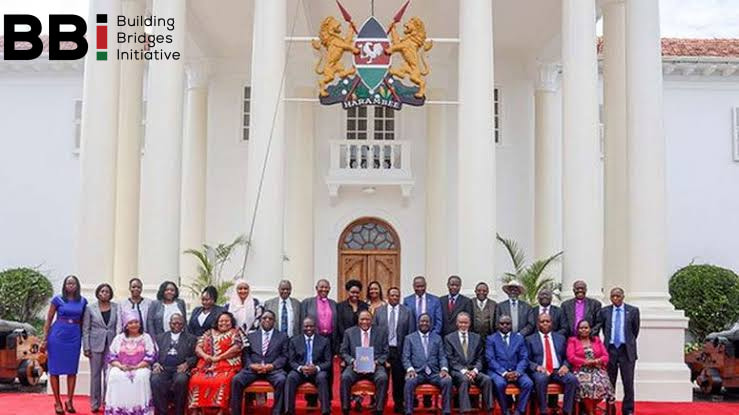
One of the greatest and universal attributes of democratic societies is free expression of political will in a referendum. This unfettered political speech is priced not just as a fundamental human right but as the foundation of consensual leadership.
Evolving democracies such as ours inevitably find themselves embroiled in loud public contestations as they seek to (re)discover themselves and find a long-term socio-economic and political footing.
Thankfully, unlike the majority of countries within the global south, Kenyans’ contestations have largely taken place within allowable and peaceful democratic confines. Over the two years or so, Kenya has been at its noisiest, set for the reprieve provided by the onset of the Cornavirus pandemic.
And it is not just Kenya that is constantly embroiled in this contest to find an agreeable governance framework. The nature of the nationhood is that it is always a work in progress, requiring constant revisions, tweaking and panel beating.
Since the end of the Cold War and emergence of a new, fluid world order that anchored democracy as a central pillar of governance and statecraft, nation-states around the world have established political reform as a norm and are constantly engaged in periodic rebooting of their governance instruments and structures, all aimed at deepening democracy. In this new dispensation, reform is the only constant.
A deepened democracy is a brand of democracy that is characterized by increased freedom, free elections, peace and stability, rule of law and a perception by the citizenry that the state is serving their best interest. A review of Kenyan political history shows that although we have made progress, there is still a long way to go.
What is amusing in Kenya is that some people tend to think that the current Constitution, just because it is very progressive, is a terminal supreme law requiring no change at all.
Yet the framers of the Constitution anticipated that the new law would need to be amended and even outlined the process of amending it for future generations.
Chapter 16 of the Constitution, Articles 255, 256 and 257 expressly provide for the amendment of the Constitution, and in two (legal) ways: The first is Article 256, which allows for an amendment through the introduction of a constitutional amendment Bill in Parliament. The second is outline in Article 257, which provides for the constitution to be amended through a popular initiative. Article 255 creates the framework and guidelines for application of either route.
It is in this context, therefore, that the much-maligned Building Bridges Initiative (BBI), which will culminate in a constitutional change, should be seen – a constitutional approach towards correcting some of the systemic wrongs as well as addressing socio-cultural, economic and political grievances which, if unchecked, stand to destroy, and have on several occasions thoroughly shaken, our nation.
A lot of time and breath has been wasted debating whether the BBI is legal, even after the court declared that President Uhuru Kenyatta acted within the law while forming the BBI team.
“There is nothing before me to show that the President acted in bad faith and there's no contradiction in the provisions of Article 132 of the Constitution,” ruled High Court Judge John Mativo on March 4, 2020.
Let it be know that there is nothing wrong in asking for greater implementation of the Constitution. But at the same time, it is important to recognise the obligation to fine-tune the Constitution to deepen Kenyan democracy. There is no democracy when citizens are not treated equally, when some citizens get more from government than others, as is currently the case in Kenya. Yet the 2010 Constitution expressly prohibits discrimination in Article 27.
We must equally reject the historical revisionism characterised by the developing narrative of personifying the process, evading the legal questions, and intentionally badmouthing the stated objectives of the imminent constitutional amendment.
For example, in no other place is this, opposition-driven, convoluted debate taking place more than in the Mt. Kenya region. With presidential aspirants aware that commanding the Mt Kenya vote is the key to winning the presidency, there is much subterfuge and propaganda being deployed to obscure the real reason why a constitutional change is necessary.
As such, no effort is being spared to ensure no meaningful debate is held, and that the people in this highly productive region reject the initiative purely on polemics and sideshows but not on a deeper understanding of their objective interest in it.
In a study known as the Kenya Accountable Devolution Programmme (KADP) 2019 conducted jointly by the World Bank and the Kenya National Bureau of Statistics on the counties’ Gross County Product (GCP), the findings established that of the top 10 contributors, four were drawn from the Mount Kenya region. These counties, Nakuru, Kiambu, Meru and Nyandarua jointly contributed 17.1 percent of the national GDP. Cumulatively, all the 10 central region counties contributed close to 30 percent of the GDP.
If you add Nairobi County, which contributes over 20 percent of the national GDP, the total contribution by Mt. Kenya region exceeds more than half of the national GDP. And this is without counting the contribution of the widely dispersed Mt. Kenya diaspora to the national GDP.
Comparatively, the bottom 10 contributors to the GDP constitute majority of the top five recipients of the national allocation. They are Mandera, Garissa, Marsabit, Wajir, and Turkana.
Five of the top beneficiaries of the national cake in the 2019/20 allocation – Turkana, Kilifi, Mandera, Wajir and Marsabit – have a combined population of 4,489,268 and received a total of Sh39.4 billion from the exchequer.
In per capita terms, at Sh8,800, this allocation is Sh3,764 more than that of the five top counties from the central region, at Sh5,036, with a combined population of 7,941,455, which only received Sh. 40.22 billion. Hence, for every one shilling a resident in the central region receives from their efforts in baking the cake, their counterparts from Turkana, Kilifi, Mandera, Wajir and Marsabit receive Sh.3,764 more, although they contributed six times less to the national GDP. These are incontrovertible facts. Now, Sh. 3,764 does not look like a lot of money but when you multiply by the number of citizens in a county, you get an astronomical figure that explains why Mt. Kenya counties are complaining of lack of development.
Resources allocation to counties – drawn from the above national cake contribution – shows clearly the unfairness in the national resource allocation. Ours is a masquerading Robinhood system without Robinhood’s moral scrapples. BBI, for all its bad name, is aimed at making things right so that no Kenyan feels he or she is being forced to carry another Kenyan on the back.
And these are the politics of underdevelopment and historical marginalisation of the central Kenya region – originating from the colonialism and penalised in the independent Kenya through skewed resources allocation. But the genius of this marginalization is that it is justified on the basis of perceived wealth of citizens in the Mt. Kenya region. Yet this assumed wealth is a mirage that is far from reality as majority of the citizens from the region are poor people without two coins to rub together.
Curing this fundamental injustice calls for specific constitutional reforms that address the questions of equity and representation; achieving both the quality of the vote and stopping underdevelopment of regions whose national contribution is channelled to other areas in total disregard of equity. This is what is being called the one-man-one-shilling-one vote principle.
And these are legal and constitutional issues that must be canvassed without the manufactured political distortions we are witnessing. Drawing from only this one example, therefore, it is important that the national conversation around the BBI is woven around factual statistics and honest grievances of the people.
However, the opponents of the reforms process wish to adulterate the debate by wishing away and embellishing facts and choosing which part of the BBI to stress for purely selfish purposes. For instance, you would think that BBI was formed merely to create more positions in the executive for politicians to divide amongst themselves. Yet the structure of the executive, while important, is dwarfed by the important questions of national ethos, corruption, equity and ethnicity.
BBI should be viewed as a genuine, well-intentioned, and necessary attempt to make Kenya a better state – part of a continuum of reforms that this country will have to undergo not just for now but in the future.
With courts having pronounced themselves on the legality of the process, the BBI should be viewed as part of what democracy is about – an organic process of which Alfred Emmanuel Smith, an American politician, once said: “All the ills of democracy can be cured by more democracy.”
Kenyans should get on with the democratic process of constitutional reform.
The writer holds a BA degree in Journalism and an MA in International Studies and is a former Director of the Nyandarua County Governor’s Press Service.0°
Read the full text: Building Bridges to a United Kenya: from a nation of blood ties to a nation of ideals (Taskforce Report, 2019) (PDF, free)
That was your last free article this month
Keep reading Viewpoints
Your free articles reset on 1 December. Members read without limits, from KSh 499 a month.
